
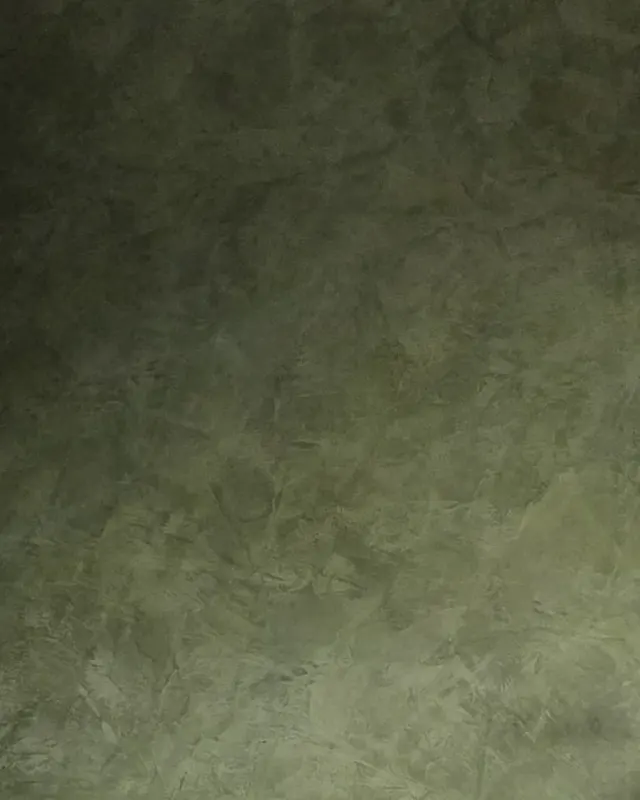
Perfectly imperfect: wabi-sabi walls
The quiet movement of a hand-finished wall is what makes a room feel calm, and alive.
Talk with Greg or Gabriel now, until 10 p.m. Text us any time. Greg or Gabriel will reply first thing in the morning.
What is wabi-sabi in interior design?
Wabi-sabi is a Japanese way of seeing beauty in what is natural, imperfect, and touched by time. In a room, it means honest materials and surfaces that show the hand that made them: limewash that clouds and shifts, clay with soft movement, plaster you can feel. Just enough variation to feel alive, never enough to look careless.
Why the eye rests on it
Nature never repeats itself exactly. Clouds, stone, and leaves hold detail within detail, and the physicist Richard Taylor’s studies of these patterns found that looking at them is easy on the eye and measurably calming.
The psychologists Rachel and Stephen Kaplan called it soft fascination: something that holds the eye gently, like moving water, lets a tired mind rest. A hand-finished wall does the same, all day long.
Just enough, never sloppy
The imperfection belongs inside the finish: its clouds, its movement, its depth. The edges, the corners, and the coverage must be exact, or the eye reads carelessness instead of character. That balance is the craft, and you approve it on a sample board before we begin.
See what goes wrong with paint and plaster for the flaws that are never part of the look.
Rooms that read like art
A flat, perfectly even wall reads as new, and then as nothing at all. A hand-finished wall changes from morning light to lamplight, so the room never looks quite the same twice, and it feels made for the people who live in it, not for a showroom.
Finishes that carry it
-
Limewash
Soft, cloudy color that shifts through the day. See limewash walls.
-
Roman and Moroccan clay
Suede-like movement, deepened with wax and warm in lamplight. See Roman clay.
-
Lime plaster and Marmorino
Texture you can feel, like a wall in an old Italian town. See Marmorino and lime plaster.
-
The Turn
Our collection of darks, made to move with the light around a room. See The Turn.
Questions about wabi-sabi walls
Is wabi-sabi the same as rustic?
No. Rustic leans on age and roughness; wabi-sabi is about honesty and calm. A wabi-sabi wall can be smooth and refined, as long as it shows the hand and the material.
Will a hand-finished wall look unfinished?
No. The movement lives inside the finish, and the edges, corners, and coverage are exact. You approve the movement on a sample board before we begin.
Does wabi-sabi work in a modern home?
Yes. Clean lines and simple furniture let a hand-finished wall carry the room, and it is often what makes a modern room feel warm instead of cold.
Tell us about the room you want to feel calm in
Greg or Gabriel replies today, or by the next business day.
Prefer to talk? Call or text (317) 795-6378.
Thank you
What happens next
- We reply today, or by the next business day at the latest, to check your dates and set a time for our visit.
- We visit with samples in the colors and textures you like.
- You receive one fixed quote, in writing.
Before we visit, gather two or three photographs of looks you love, and keep any fabric, tile, or stone you want us to match nearby.
To speed things up, text us a photo of the space.
Greg and Gabriel